
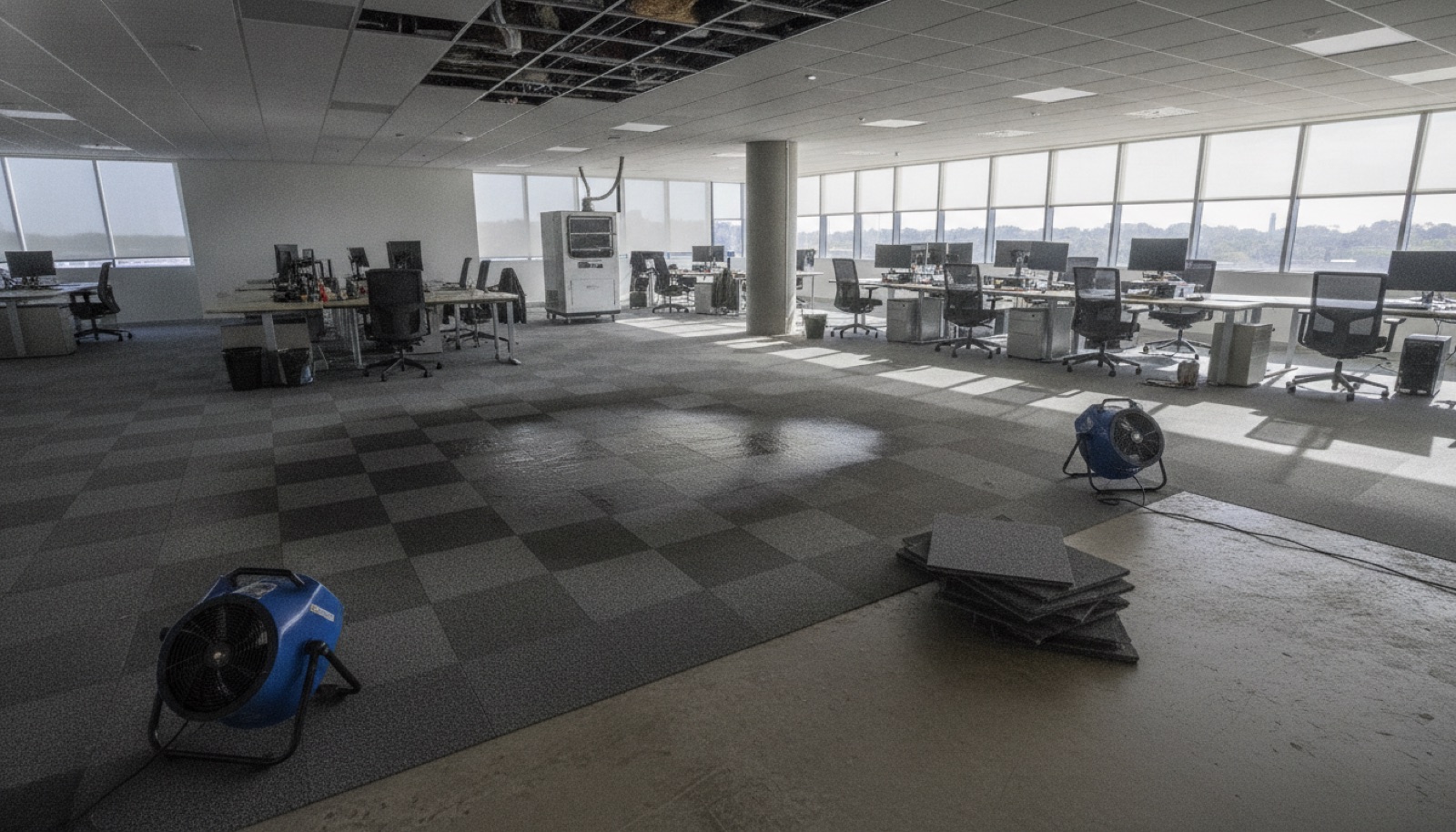
When our maintenance team gets a call about a burst pipe, a roof leak or a sprinkler head that has gone off, the first job is always to stop the water. By the time we get there, though, the water has usually found the carpet. In offices, shops, clinics and schools, how that carpet is handled over the next day or two can decide whether the space is back in use quickly or facing a much bigger repair.
This is what we suggest building and facility managers focus on, in order.
First, stop the water and make the area safe
- Isolate the supply. Know where the isolation valves are for each floor and tenancy before you need them. If you cannot find the right one, isolate further back and let the plumber narrow it down.
- Leave sprinkler isolation to the right people. A sprinkler system protects the whole building, so it should only be isolated by your fire services contractor or someone authorised by building management, and put back into service as soon as the damaged head or pipe is repaired.
- Keep people away from wet electrics. If water has reached floor boxes, power points, light fittings or equipment, keep people out of the area and do not switch anything back on until a licensed electrician has checked it.
- Manage the slip risk. Wet floors are slippery. Cordon off the area rather than relying on people to notice.
Work out what kind of water it is
Not all water damage is the same, and the source changes what can be saved. The WA Department of Health’s guidelines for managing mould and dampness in buildings group water into three categories:
- Category 1, clean water: for example, broken water supply lines, taps and rainwater.
- Category 2, grey water: water with some contamination, such as drain water and water from fire hydrants.
- Category 3, black water: sewage, toilet overflows and floodwater from rivers or streams.
On the job, the category on paper and the water on the floor are not always the same thing. Rainwater that has come through a roof and a ceiling has picked up whatever was in the ceiling space on the way down. Water that has been sitting in sprinkler pipework can come out discoloured and smelly. Whoever deals with the carpet needs to know exactly where the water came from, so tell them.
Sewage is a different job altogether. HealthyWA’s clean-up advice for wastewater overflows says saturated carpet generally cannot be adequately cleaned once it has been contaminated by wastewater, and should be removed and replaced where possible. Treat anything the wastewater has touched as contaminated, and make sure anyone involved in the clean-up is wearing protective equipment such as gloves, boots and coveralls.
Why the first 48 hours matter
For clean water damage, the same WA Health guidelines say carpet and its backing should be dried within 24 to 48 hours, and they flag that problems start when porous building materials stay wet for more than 48 hours. Their recommended steps are straightforward:
- remove the water with a water extraction vacuum
- reduce humidity in the space with dehumidifiers
- speed up drying with fans
- clean and dry the subfloor under the carpet as well, not just the carpet itself.
That last point is the one that gets missed. Carpet can feel dry on top while the backing and the slab underneath are still holding water. With carpet tiles, lifting the tiles in the wet zone lets you see the floor and dry it properly. With glued-down broadloom, get a moisture reading rather than going by touch.
What you can do before help arrives
- Record everything. Take photos and video of the water, the source and the affected carpet before anything is moved. Your insurer and the building owner will want them.
- Clear the wet area. Move paper, archive boxes, electronics and loose furniture off the wet carpet.
- Protect the carpet under heavy furniture. Where desks or cabinets cannot be moved, slip something waterproof, such as plastic blocks or foil, under the legs so timber and metal do not stain the damp carpet.
- Do not use a standard vacuum cleaner on wet carpet. Extraction needs equipment that is designed for water.
- Do not just close the door and wait. Wet carpet left in a shut, still room is exactly the situation the 48-hour guidance is warning about.
Drying the carpet is not the same as cleaning it
Extraction and drying stop the damage from getting worse. They do not make the carpet clean. Once water has soaked through a carpet, brown tide marks can appear around the edge of the wet patch as it dries, along with dirt drawn up from the backing and a musty smell if drying was slow.
Once the leak is fixed and the carpet and subfloor are properly dry, bring in local carpet cleaners to deal with the marks and give the whole area an even finish, so the affected patch does not stand out from the rest of the floor. A low-moisture method makes sense on carpet that has only just been dried out. Magic Dry, a WA business since 1971, uses a dry cleaning method where carpets are dry in about two hours.
If the carpet was affected by sewage, or it stayed wet well past that 48-hour window, talk to your insurer and a water damage restoration specialist before booking a clean, because replacement may be the better option.
Fix the cause so it does not happen again
Carpet can be dried and cleaned, but if the cause is not properly repaired you will be doing it all again. Water in commercial buildings can come from a failed flexible hose under a kitchenette sink, a split fitting in the ceiling space, a blocked box gutter or roof outlet, or a sprinkler head knocked during ceiling works.
Our maintenance division responds to burst pipes, blocked drains and fire main issues 24 hours a day, 7 days a week, and our commercial plumbing team carries out preventative maintenance and works on fire protection systems for buildings throughout WA. A planned maintenance program that checks valves, hoses, roof drainage and fire services usually costs far less than replacing a floor of carpet.
If water is coming through your ceiling right now, our lines are open 24 hours a day, 7 days a week for emergencies. You will find the number on our contact page.